
Music of the Regiment – April 18 & 19, 2026
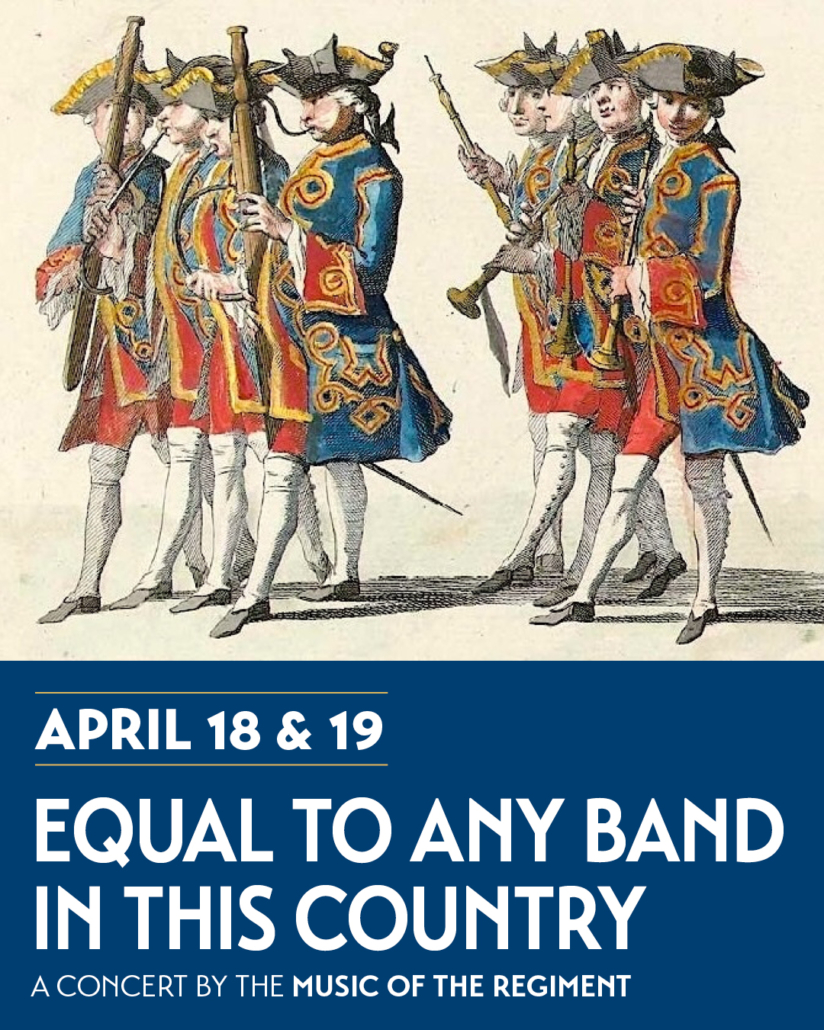
By the American War of Independence (1775–1783), the regimental band had become a staple of European martial life.
Distinctly different than fifers and drummers who held military responsibilities, musicians who performed in bands were professionally trained instrumentalists whose first job was to entertain. Bands typically consisted of two to four clarinets or oboes, two French horns, and one or two bassoons. These musicians were also expected to double on string instruments. Their repertoire spanned marches and troops, country dances and minuets, and wind divertimenti and theatrical arrangements.
Despite the dramatic hurdles that stood between the Continental Army and American independence, certain American officers made extraordinary efforts to form bands of their own. Ultimately, four American colonels raised and sustained bands during the war. Today’s program follows the story of Colonel Christian Febiger (1749–1796) and the band of the 2nd VA Regiment.
Febiger was born in the Danish port town of Fåborg in 1749. While we don’t know much about his early childhood, we do know he was raised in a household that valued music and organization. Both his father and eldest brother were church organists and clerks, and, following his formal schooling, Febiger travelled to the Danis
Febiger immigrated to New England in 1772, and three years later took up arms for the American cause when war broke out in April 1775. He fought at Bunker Hill and then, under the command of Benedict Arnold, participated in the disastrous raid on Quebec City. He was held captive for a year, and—following his release—donned his uniform again, distinguishing himself at the battles of Brandywine, Germantown, and Monmouth.
On July 16, 1779, “Old Denmark” led soldiers into battle for the last time, conducting a midnight raid on the British fortification at Stony Point, NY. The battle was an overwhelming American victory and about 550 British soldiers were captured. Among the British POWs were musicians from the band of the 17th Regiment of Foot. Not only were these poor musicians taken prisoner, but their instruments were also confiscated and sold.
An addendum to the manifest of materials captured reads:
“In addition to the ordnance and military stores I am desired to appraise 2 French Horns, 2 Bassoons, 2 Clarinets… the Light Infantry have been offered one thousand dollars for them by some individuals…”
We unfortunately do not know who bought these instruments, but, in December of the same year, Febiger began raising his own band. Though completely conjecture, it is not unreasonable to imagine that being in proximity to this sale—if not a part of it—sowed a seed.
Following the engagement at Stony Point, Febiger transitioned into a more administrative role. He wasn’t officially relieved of his field command,—he had been Colonel of the 2nd Virginia Regiment for two years already—but his new duties removed him from the camp and planted him in Philadelphia. There he got to work organizing everything from recruitment to the transportation of military stores. It was during these months that he also:
“…reenlisted 7 or eight Young Fellows Natives of our State [Virginia], bought instruments and provided two Masters to teach them and they have made such progress, that without Vanity I can say that they are equal to any Band in this Country…”
These men were all serving officially as fifers in the 2nd VA Regiment. Thomas Sheldon—the regiment’s Fife Major and senior musician—was designated their leader. It is unlikely, however, that any of them actually had formal music training before December 1779. They studied with “Mr Schuetz, a German musician,” and by March the ensemble was fully double handed: four clarinets who could also play violin, two French horns, and two bassoons doubling on “bass viol.”
Febiger left Philadelphia with his band in the Spring of 1780. Over the next year, Febiger’s band “had more Influence on the minds and Motions of [Virginia’s] Militia than would the Oratory of a Cicero,” and their performing was apparently as inspiring “as a well spoken recruiting Sergeant.” Regrettably, more information concerning their specific repertoire has yet to be revealed, but today’s program serves as an homage to their sound world, with a particular nod to the British bands Febiger would have been exposed to earlier in the war and the French bands that marched through Virginia in 1781.
Those French bands—of which there were at least three—accompanied an expeditionary force led by the Comte de Rochambeau. Together, Washington and Rochambeau orchestrated the siege at Yorktown, Virginia in October 1781 that marked the official beginning of the end of the British war effort. As the surrendering British marched out of the bombarded seaside town, a Hessian soldier recalled, “the Americans were on our left… They had bandsmen making beautiful music and who presented a decent appearance.”
The question of who this band belonged to has been left open and widely ignored, but evidence from pension records along with good-old-fashioned process of elimination—three out of four of the American bands were still stationed in the north—strongly suggests that these were the musicians of Febiger’s ensemble. It would be their highest honor, and yet so many of its details are still shrouded in mystery.
The reality was that—despite that victory—the war was not yet over. The trials and tribulations of that reality remained very present in the lives of common soldiers. As tensions—and hunger—in the ranks grew, the band helped deescalate at least one mutiny in 1782. As the war wound down the next year, the band dissolved one by one as its members were discharged. This seems to be the end of these musicians’ musical careers. Most of the bandsmen were issued land warrants and disappeared into history. After the war, Febiger went back to Philadelphia and enjoyed a successful postwar career in business and government until his death in 1796.
© Music of the Regiment


