
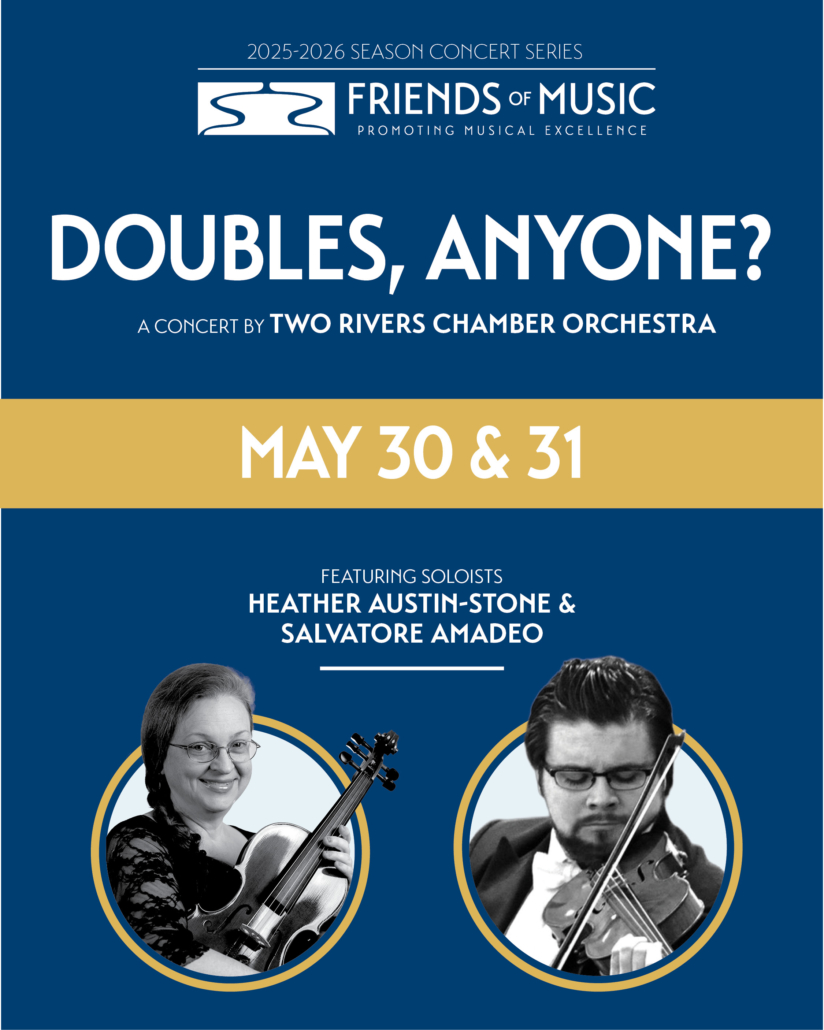
Doubles, Anyone? – May 30 & 31, 2026
Osvaldo Golijov
(Born in La Plata, Argentina on December 5, 1960)
Last Round
1. Movido, Urgente – “Macho, Cool, and Dangerous”
2. Lentissimo – “Deaths of the Angel”
The Argentine composer Osvaldo Golijov’s Last Round is a chamber work that honors the tango, Argentina’s beloved song and dance form, and serves as an elegy for two of tango’s greatest composers. Golijov is one of the world’s most sought-after new composers. Born and raised in Argentina (now residing in Massachusetts), Golijov grew up under the influence of the “tango of the old guard,” which was lyrical, urbane, and gentlemanly, and which was exemplified by the actor, singer, and composer Carlos Gardel (1890–1935), who especially endeared the world to the beauties of tango with his famous 1930s tango song, Mi Buenos Aires Querido (“My Beloved Buenos Aires”). After Gardel came the Argentine composer Astor Piazzolla (1921–1992), whose tangos in the 1960s challenged the “old guard” tangos with a new approach that he called the Nuevo tango. As Piazzolla explained, “Nuevo tango = tango + tragedy + comedy + whorehouse.” One of Piazzolla’s most famous, early tangos, La muerte del ángel (“Death of the Angel”), with its highly syncopated rhythms and its complex harmonies, epitomized this Nuevo tango philosophy, and his highly popular approach won him national hero status in Argentina and worldwide acclaim.
At the peak of his fame, Piazzolla unexpectedly suffered a major stroke in 1991 (leading to his death the following year), and this tragic loss led Golijov to sketch a musical elegy for this great tango hero. In 1996, this elegiac sketch would become the second movement, Lentissimo, of a larger work, Last Round. Golijov described its development:
I composed Last Round in 1996, prompted by Geoff Nuttall and Barry Shiffman [two of the founding members of the celebrated St. Louis String Quartet, who]… encouraged me to finish [the Lentissimo] and write another movement to complement it. The title is borrowed from a short story on boxing by Julio Cortázar, the metaphor for an imaginary chance for Piazzolla’s spirit to fight one more time (he used to get into fistfights throughout his life).
Part of Last Round’s charm is Golijov’s unique orchestration, which tips its hat to tango’s dance hall orchestra origins — here, two small string ensembles (two string quartets) face each other on stage, moderated and anchored by a double bass in the middle. Golijov also wanted his string ensemble to mimic a bandoneón — a button accordion — which is one of the tango’s integral instruments, and the one that Piazzolla so often wrote for. Last Round’s premiere in 1996 was hugely successful and the work has remained popular.
The first movement, Movido, Urgente (restless and urgent), has as its subtitle “Macho, Cool, and Dangerous” and suggests the tangos from the rough-and-tumble musicians of Buenos Aires’s underbelly. Wheezing and snapping, Golijov’s “string-bandoneón” creates a jangled, and altogether joyful, roughneck dance. Occasional increases in tempo invite machismo from the competitive tango dancers, while the movement’s jaunty, almost chaotic, rhythms echo the same kind of rhythms that Piazzolla adored and exploited in his 300-plus tangos. The movement dances dangerously to its final, exciting bars, and then, at about six and a half minutes, a long, mournfully descending sigh transitions the music into the next movement without a pause.
The second movement, Lentissimo (very slowly), is a threnody for Argentina’s two great tango composers and is hauntingly lamenting. Its subtitle, Muertes del ángel, does not so much quote Piazzolla’s groundbreaking 1960s tango of that name as riff on his title, using the plural “deaths,” in homage to the two departed composers, Gardel and Piazzolla, who have themselves become “ángels.” Golijov begins by imagining what a bandoneón could do if it never had to change between compression and expansion, how it might sing in one gigantic, long pull. At first, melancholic and atmospheric music pervades, but then, little by little, bits of a tune float up from the musical mist. These tune-wisps finally come together, near the middle of the movement, when Golijov at last quotes outright Gardel’s chorus from his Mi Buenos Aires Querido. And then to its end, the movement rhapsodizes, grapples, and pulses on Gardel’s refrain and Golijov’s “endless pull” bandoneón, with beauty and bittersweetness.
Together, these two movements create a spiritual, earthy, sexy, and ecstatic tango which, as Golijov describes, is a
… sublimated tango dance. … The bows fly in the air as inverted legs in crisscrossed choreography, always attracting and repelling each other, always in danger of clashing, always avoiding it with the immutability that can only be acquired by transforming hot passion into pure pattern.
Johann Sebastian Bach
(Born in Eisenach, Germany, on March 31, 1685; died in Leipzig, Germany, on July 28, 1750)
Concerto for Two Violins in D minor, BWV 1043
1. Vivace
2. Largo ma non tanto
3. Allegro
The German composer Johann Sebastian Bach’s exceptionally popular Concerto for Two Violins was most likely composed in 1730 in Leipzig, Germany, for performance by the Collegium Musicum. This extraordinary organization had been founded a few decades earlier in 1702 by Georg Philipp Telemann (1681–1767) for the purpose of training music students and to provide free public concerts. The collegium concerts were held weekly at Gottfried Zimmermann’s large and posh coffeehouse in a wealthy part of Leipzig with the music played by students, teachers, and professional musicians. The sale of coffee to the patrons during these weekly events was always more than enough to allow Zimmermann to present these concerts for free. The music series was lucrative and extremely popular, and for their programs, new works were typically created by the collegium’s director.
In 1723, Bach was hired as Leipzig’s new Tomaskantor, the music director of both Leipzig’s main music school and the city’s four main churches. Six years later, Bach also became the director of Telemann’s Collegium Musicum, which required a variety of new compositions: overtures; sinfonias; concertos for strings, winds, and keyboards; and duo and trio sonatas—many of which Bach and his children performed along with the collegium’s pupils as soloists. Tonight’s Concerto for Two Violins was very likely one of these new collegium works, as were many of Bach’s most beloved secular works, including his Concerto for Violin in A minor, BWV 1041, and one of his most humorous pieces, the cantata-like work called Be Still, Stop Chattering, BWV 211, also known as his secular Coffee Cantata.
As the title indicates, Bach’s Concerto for Two Violins is cast for two soloists, but although each soloist is treated as a virtuoso in the Baroque fashion, they are also treated as a kind of collective soloist — often playing together in harmony, or in unison, or in duet, or in tumbling imitation, as if they were a single, extended instrument. And as listeners have felt for centuries, there is magic to this concerto that makes it one of Bach’s greatest, with its impressive contrapuntal treatment and unique lyrical beauty, and perhaps above all, with its tapestry-like sophistication. It served Bach so well in his own time, too, that he recast the work in 1737 as a Concerto for Two Harpsichords in C minor, BWV 1062.
The first movement of his Concerto for Two Violins, Vivace (lively), begins with the “second” solo violin (this is a notational designation rather than a hierarchy) presenting the main ritornello theme of the movement — the Baroque ritornello was a structural form that featured a musical section that would continually return after alternating with contrasting musical “episodes.” This second solo violin’s opening ritornello theme is delightfully vivacious and carefree, dancing upward and downward and again upward. The “first” solo violin then plays this passage, too, but transposed up five steps in pitch, and soon after, the string bass enters with yet another iteration of it — everything sizing up to sound as though a great fugue is developing. But instead, inventively, Bach directs all this musical movement into constantly morphing counterpoint between the soloists and the orchestra, like a shifting kaleidoscope. What magically stands out from all this happy busy-ness, however, is how the music boils with virtuosic élan. Soon, the first episode begins with a new theme in which the two soloists dance acrobatically around each other in a duet of agile grace. The ritornello and episodes alternate quickly throughout this movement, and when the ritornello returns for the third and final time, the movement comes to a surprisingly gentle close.
The second movement, Largo ma non tanto (slowly but not too much so), is considered one of Bach’s most beautiful movements — one musicologist called it “the greatest eight minutes in music” — and it deserves its popularity. Beginning with the second solo violin, a lovely descending theme unfurls slowly as the main theme, which is soon joined by the first solo violin. From here, the two soloists play an extended love duet — tender and touchingly vulnerable — above an understated accompaniment from the orchestra. This Largo is also built as a ritornello, but in an unusual treatment of this form, the two soloists dominate the entire movement, with the alternate episodic sections evoking a kind of domestic contentedness as the two violinists dance closely, even finishing each other’s phrases, then returning to the home (ritornello) theme.
The final movement, Allegro (fast), begins with a bright and joyous sparkling of counterpoint from the entire ensemble while the string bass provides a brisk and steadfast “walking bass” beneath it all. This Allegro is also a ritornello, with its main section surprisingly brief. Throughout the movement, Bach employs lots of imitative counterpoint between the soloists (and all the orchestral instruments, too), overlapping it in such a way that even before a musical phrase from one soloist ends, the next soloist imitates it. As such, this movement is near hypnotizing in its constant melody making. Particularly fun to hear, at about one and a half minutes, is the alternating episode in which Bach gives the two soloists a long sequence of four-note chords to play as the rest of the orchestra somersaults in counterpoint beneath them. This movement demands more virtuosity from the two soloists, too, but Bach also infuses a few longer, lyrical lines for the soloists at the least expected times — in the midst of such cavorting counterpoint, these expressive moments truly soar. The movement thrums and captivates until its final bars, ending without fanfare, yet still resonating with dazzling energy.
Antonin Dvořák
(Born in Nelahozeves, Bohemia (now Czech Republic), on September 8, 1841; died in Prague on May 1, 1904)
Serenade for Strings in E major, Op. 22
1. Moderato
2. Minuet – Allegro con moto
3. Scherzo – Vivace
4. Larghetto
5. Finale – Allegro vivace
Early in his career, the Czech composer Antonin Dvořák struggled to be recognized as a composer outside of Prague, but then in 1875, he received a much-needed boost. He entered a composition competition held in Vienna that was founded to help young artists receive pay, commissions, and attention. On the panel of that Vienna competition’s three famous judges was Johannes Brahms, and each of them recognized Dvořák’s exceptional talents, granting him the top prize, and Brahms himself becoming one of Dvořák’s most important supporters from then on. To top off his musical success, Dvořák had just recently married and welcomed his first son into the world. His life in 1875, after years of professional hardship, was finally looking up and inspiring him into a period of extraordinary music writing.
With acclaim and financial breathing room provided by the competition award, Dvořák seemed to pour that good fortune into one of his next compositions, his 1875 Serenade for Strings, Op. 22. Written in only 12 days, the Serenade is a set of five short instrumental movements for string orchestra beaming with melodious beauty and good cheer, written as though it were created from the pure joy of composing. Hugely popular at its 1876 premiere in Prague, the Serenade further expanded Dvořák’s reputation and has remained one of his most beloved works. The success that Dvořák realized with this work’s neoclassical “serenade” form (a form well associated with Mozart’s famous serenades, like his Eine Kleine Nachtmusik) influenced his choice to use this serenade form again for one of the commissions that came from his Viennese competition celebrity, his hugely popular Serenade for Winds of 1879, a work that helped propel Dvořák to international fame.
The first movement of his Serenade for Strings, marked Moderato (moderately paced), begins with a bucolic gentleness that permeates the entire five movements and showcases Dvořák’s great gift for melody. The opening theme is a very singable tune, first sung in the violins, then answered by the cellos, and underpinned by steady, pulsating violas. Although this is a strings-only ensemble, we hear what sounds like a large, rich orchestra of strings, an effect achieved by dividing each of the string sections into multiple parts (a technique called divisi), thereby expanding their harmonies, registers, and harmonics. Dvořák initially keeps the ensemble in the lower registers which creates a soft, autumnal sumptuousness, but soon the softness and registers begin to soar in intensity and into higher, happier realms, ending the movement with a delicate, feathery touch.
The graceful second movement waltz, Minuet – Allegro con moto (fast with motion), begins in a minor key with a sweeping, twirling, yet somewhat melancholy, theme. The phrase lengths vary as the theme branches out, leaving a slight sense of imbalance, creating one of Dvořák’s most beautiful musical moments. The middle section, Trio, is equally gorgeous yet ambiguous, dancing with a lazy kind of skipping rhythm that is inflected with wistful nostalgia and accented with moments of drama. The opening music returns to finish this lovely and evocative movement.
The next movement, Scherzo – Vivace (lively), is exciting and quicksilvered. The opening theme’s imitation is canon-like between the cellos and the upper violins and creates a feeling of unbridled joy before pausing for a gentle contrasting section — a love song with several delicate refrains. The Scherzo’s concluding section is a brief and magical meld of these two musical ideas.
The fourth movement, Larghetto (rather slowly), is the Serenade’s weightiest movement, although it retains the whole work’s overarching pastoral mood. Like Mozart’s late-career slow movements, Dvořák’s Larghetto captures an ineffable heartache wrapped in otherworldly radiance. The main theme is made of a step down followed by a large descent — like a sigh and a falling tear — which then sequences through several iterations. This is a thematic technique that Dvořák would use more often in his works to come, but here, one gets the sense that this step-sigh theme reflects deep bliss rather than sorrow. A brief middle section contrasts this mood with uncertainty, but it is fleeting, as the movement returns to its main theme to close in quiet tranquility.
The Finale movement, Allegro vivace (fast and spirited), begins with a quick-paced call-and-response theme between the upper and lower strings. The theme skips in and out of minor and major modes, filling it with a sense of excitement and urgency, driven along by a motoric pulsing from the rest of the ensemble. As the music courses along, the falling-tear theme from the fourth movement unexpectedly arises (at about two minutes, in the cellos), followed then by the bucolic main theme of the first movement (at about two and a half minutes later, in the second violins), giving this bustling finale a sense of smiling reflection. But then, the final bars bolt toward the Serenade’s bright, bold, and brilliant ending.
© Max Derrickson


