
Double Down: Two Cellos, Twenty Strings – November 15, 2025 – 7:30pm
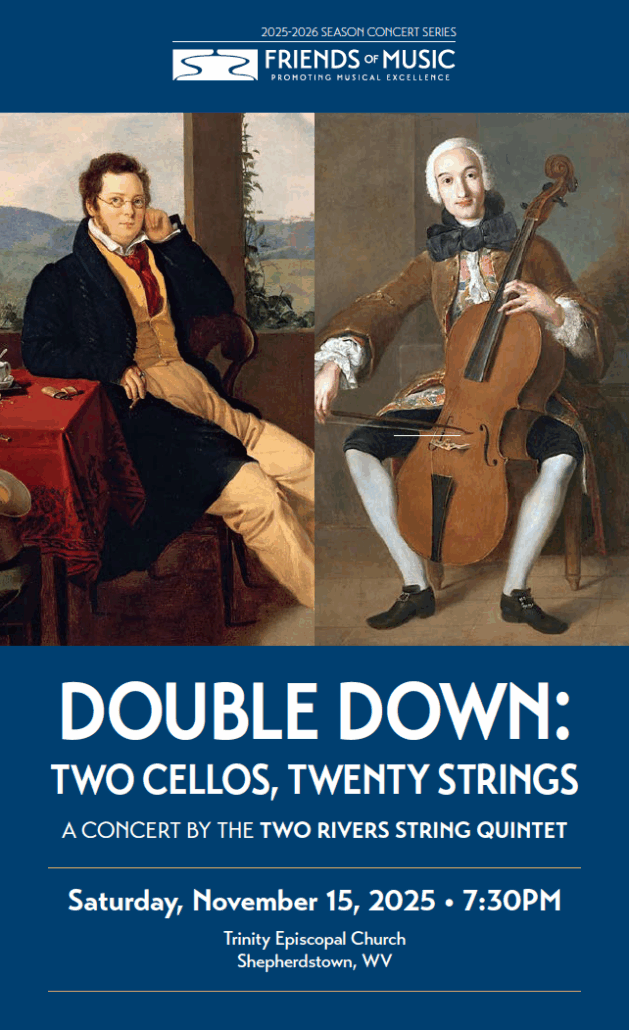
Luigi Boccherini
Born in Lucca, Italy, in 1743; died in Madrid, Spain, in 1805
String Quintet in C Major, Op. 30, No. 6 (G. 324)
La Musica notturna delle strade di Madrid (Night Music of the Streets of Madrid)
- Le campane de l’Ave Maria (The Ave Maria Bell)
- Il tamburo dei Soldati (The Soldier’s Drum)
- Minuetto dei Ciechi (The Minuet of the Blind Beggars)
- Il Rosario — Largo assai, allegro, largo come prima — (The Rosary)
- Passa Calle de Los Manolos — Allegro vivo — (The Passacaglia of
the Street Singers) - Il tamburo (The Drum)
- Ritirata — Maestoso — (The Retreat of the Madrid Military Night Watch)
Luigi Boccherini was born in Italy and began his musical life as a cello prodigy. His debut concert occurred when he was 13 in his hometown of Lucca, and soon after, he and his father traveled to Vienna to show off Luigi’s talents. At the age of 22, he impressed audiences in Paris, including the Spanish ambassador to France who encouraged the young Boccherini to go to Madrid. Boccherini arrived in Madrid in 1768, and two years later he became “virtuoso of the chamber and composer of music” for the Royal Court of Infante Luis Antonio, the younger brother of King Charles III of Spain.
A few years later, political machinations led Charles to banish Luis to the small town of Arenas de San Pedro, Spain. Boccherini soon followed Luis, and on the condition of their staying in that small village, the king supported them with a generous patronage. It was here, from 1776 almost until his death in 1805, that Boccherini wrote his finest works. Usually, the only court musicians that Infante Luis had at his disposal in Arenas were members of a small string orchestra, so most of Boccherini’s compositions were for string ensembles. Aside from a few dozen fine symphonies and 12 cello concertos, Boccherini wrote more than 100 string quartets, trios, and sonatas; more than 100 general chamber works; and more than 100 string quintets for various combinations.
Boccherini’s idea of writing string quintets for two violins, one viola, and two cellos (rather than the more typical two violas) came to him in Arenas and was a natural invention for him as a virtuoso cellist. He composed a particularly excellent set of two-cello string quintets in 1780 (counted as G. 319–324), the sixth of which, Quintet in C Major, La musica notturna delle strade di Madrid, was a rare programmatic piece describing the many songs and sounds of a typical night in Madrid. The set made its way to Berlin before Boccherini’s death but wasn’t published until much later (first in 1822, and then in 1921 as the first “official” publication in Paris). Boccherini himself said that no one outside Madrid would understand the work because of the quintet’s hyperlocal representations. Nonetheless, the quintet’s fame blossomed throughout Spain, such that Boccherini reused the tune of its last movement (Ritirata) for three of his later works. The entire work is surprisingly inventive for its time, brimming with imagination and delightful tunes and containing interesting instructions from the composer. The movements are quite short (often under a minute, with no movement longer than three minutes), and they occasionally wander into the next movement without much break.
The first movement is one of the shortest and perhaps most ingenious. Titled Le campane de l’Ave Maria, it represents the ringing of a particular set of bells, the Ave Maria church bells, as the main church in Madrid calls the faithful for end-of-day prayers. Boccherini instructs the musicians to pluck their instruments with “all [strings] pizzicato imitating the sound of the bells when the Ave Maria is rung.” Three slow and somber chords — spread throughout the second violin, viola, and two cellos — “strike” three repeated chords in three sequences, with no tune, just representing the hollow, clanging sound of these meaningful bells. With dusk having arrived in Madrid, and the faithful so evocatively called and engaged in prayer, Boccherini moves to his next nocturnal evocation.
The second movement, Il tamburo dei Soldati (The Soldier’s Drum), is played by solo 1st violin. Boccherini instructs the violinist to “imitate a military drum” by forcefully playing a vigorous rhythm on a repeated low C. (Occasionally, the 1st violinist waits offstage until this movement, entering the stage for the first time playing this rhythm.) The effect is dramatic and conjuring — here, the local military barracks are preparing themselves for the night patrol of the city. This passage is brief and marches directly into the third movement.
Next is Minuetto dei Ciechi (The Minuet of the Blind Beggars), in which Boccherini recalls the locally famous groups of blind musicians performing in the streets for charity. Apparently, not all groups were composed of expert musicians, however, as Boccherini instructs the quintet to play con mala grazia (with clumsy grace). He also asks the two cellists to hike their instruments up on their knees and strum them like guitars “with their fingernails.” Over that strumming and some light harmony from the viola, the two violins play a catchy tune that is suitable for dancing but also a little awkward. In the second phrase, the tune is loud and “harsh.” Delightfully redolent of this unique kind of folk ensemble, the whole movement, even with its repeats, lasts less than a minute and a half.
The fourth movement, Il Rosario (The Rosary), brings us inside a church where the prayers of the Rosary are being intoned in harmony by two priests, played by the 1st violin and 1st cello. Bewitchingly, the cello plays high in its register — a third above the violin — creating a very rich sound. Boccherini asks that the two “singers” play “sweetly and gracefully,” without strict attention to tempo. For spiritual emphasis, an acolyte rings a small handbell, represented by the 2nd violin occasionally plucking two high pitches. The tune is contemplative, much like a prayer might be sung, until about one and a half minutes when the tempo speeds up and the entire quintet plays a brief and rousing refrain from the congregation. The officiants return to the prayer, now with the cello playing a reservedly rhapsodic accompaniment and being asked to “imitate a bassoon” — it was customary at the time in Spain for prayers to be sung accompanied by a bassoon or an instrument like it. The sequences alternate several times until the movement ends with the congregation’s final response.
Out of the church and back onto the streets at night for the fifth movement, Boccherini now conjures the Passa Calle de Los Manolos (The Passacaglia of the Street Singers). (The performance of this tune, incidentally, became more famous recently in Peter Weir’s 2003 film, Master and Commander, starring Russell Crowe.) Manolos were a typical group of singing and playing street buskers that became beloved and yet somewhat notorious in 18th and 19th century Madrid. The manolos strutted with confident grace but were keen on mischief — they distinguished themselves by singing vulgarly in the early evenings, cavorting a little, and attracting attention from passersby. They were generally not appreciated by polite society. Here, the tune Boccherini created is representative of the manolos’ fun-lovingness and swagger. The movement has come to be called a “passacaglia” (a serious Baroque musical structure), but this was at some point confused with its true origins, pasa calle (along the street), in reference to where the manolos would sing and dance seguidillas (a popular Spanish dance form). As the two violins are instructed to strum like guitars, the viola and 2nd cello pluck away at a peppy pace, setting the harmonic field for the 1st cello to sing a song to all who may, or may not, wish to hear. The song is tuneful and filled with little runs that speak bravura in curious phrase lengths, as though the soloist may be inebriated. Out of the blue, the 2nd violin bursts into a rhapsodic and virtuosic little cadenza — obnoxiously intruding — and then fades out. The whole song and dance are repeated, yet interrupted profoundly by the violinist, and the piece then runs straight into the sixth movement, shut down by the military drum.
In Il tamburo (The Drum), the 1st violinist again plays a vigorous rhythm, this time calling the military to signal citywide curfew and the conclusion of the night watch.
This final movement, Ritirata (The Retreat of the Madrid Military Night Watch), begins as the “drum” concludes. The tune is one of Boccherini’s most famous, though in fact it was composed around 1761 by King Charles’s chamber musician, Mauel Espinosa de los Monteros. Monteros’s Ritirata was used to call all soldiers back to their barracks, whether on duty or carousing on leave. Boccherini uses Monteros’s tuneful melody here, transforming it into a rather regal affair in 11 variations. In those variations, different members of the quintet play a perpetually repeated rhythm in imitation of a military drum – beginning with the 1st cello, and then to the 2nd cello, then the 2nd violin, and lastly the viola. Generally, Boccherini wanted this movement to start very quietly, as though the military band’s calling of all wayward soldiers had begun far down the avenue. Gradually, the volume would grow as if the band were approaching and then passes by to fade into the distance and into the night. Other versions exist, however, that do not specify this transit and sonic shift, giving the tune itself more gravitas. The final variation brings this wonderful piece to an end, leaving a delightful feeling of having just experienced an evening in 18th century Madrid.
Franz Schubert
Born in Vienna, Austria, in 1797; died in Vienna, Austria, in 1828
String Quintet in C Major, D. 956
- Allegro ma non troppo
- Adagio
- Scherzo: Presto — Trio: Andante sostenuto
- Allegretto
In the final two years of his life, between 1827 and his death in November 1828, the barely 31-year-old Schubert was a genius on fire with ideas and compositional accomplishments. In this short time, Schubert wrote, or began, more than 60 works spanning nearly every genre, including multiple masterpieces: the C Major Symphony, his last three Piano Sonatas, the song cycle Winterreise, several Masses, and his last instrumental masterpiece, String Quintet in C Major, composed for two violins, one viola, and two cellos. The latter was written in under two weeks, just two months before his death. As the British composer Benjamin Britten (1913–76) said, this astounding period in the great composer’s life may be “the richest and most productive 18 months in our [Western] music history.”
This exceptional quintet has captured many hearts and minds since its posthumous publication in 1853 and is now considered to be Schubert’s greatest chamber piece. With its joyfulness, exquisite lyricism, and intimate emotion, it is widely cherished as one of the most moving pieces in the entire chamber repertoire; words such as “sublime” and “bottomless pathos” have been used to describe it. Having written more than 15 string quartets and countless works for string ensembles, Schubert had previously only dabbled during his teenage years with an all-string quintet. And although the precedent of using two cellos in a string quintet had been set by Italian composer Luigi Boccherini around 1780 (also performed tonight), Schubert was likely unaware of it. Instead, for this late quintet, Schubert was probably inspired by his heroes, Mozart and Beethoven, who had created quintets that included two violas (instead of two cellos). But Schubert’s imagination for sonic density was now entering a magical phase, and this use of two cellos creates amazing fields of sound, dense and singingly rich, rippling with athleticism.
The first movement, Allegro ma non troppo (fast but not too much), opens with a long chord that grows and dims in luminosity and over the next several bars blossoms into a gentle, but slightly restless, short theme. As the movement gathers vitality, at about one minute, Schubert unleashes the exuberant power of the two cellos as they play in unison, octaves, or harmony. The crowning theme of the movement occurs about a minute later, played as a soaring and singing cello duet. This theme is without care, tenderly lyrical and affable, and is often regarded as one of Schubert’s most magnificent. Even with sure moments of dramatic passion, the movement abounds with cheerful freshness and imaginative instrumental combinations, until it winds calmly down to its final bars, first capped with an exclamatory chord, and then with a soft goodbye.
The second movement, Adagio (slowly), is a tempo rarely used by Schubert. This movement is more timeless than slow, as it quietly unfolds. The music is gentle, slyly rhapsodic, and beckoning. The long opening theme is played by the three inner voices of the quintet (the 2nd violin, viola, and 1st cello) which create a slowly winding hymnlike tune that luxuriously harmonizes around itself. Underneath this hymn plucks the 2nd cello, lazily, solidly, unhurriedly. Overtop, the 1st violin gives an equally unhurried, but pensively self-absorbed, commentary, quietly filling in the spaces between the long-held notes of the inner voices’ theme. After about two and a half minutes of this beautiful wandering, Schubert sneaks in a truly sublime chord of B minor — a tonal region that he seemed to save for moments (and works) of greatest pathos. Here, it appears like an apparition of incomparable sadness, and then it vanishes into the next beat. This air of timelessness is interrupted by a dramatic and virtuosic middle section, and then the opening music returns, featuring the 1st violin and 2nd cello in a delicately quiet, yet virtuosic, duet over that long flowing hymn. When their conversation finally calms, the movement settles into a serene, ethereal conclusion.
Schubert had a lifelong love of dance music (he wrote over 500 dances in his short career) and the third movement, Scherzo presto (very fast), is a frolicking dance, complete with country stomping double-stops in the two cellos and hunting-horn heralding in the violins. Every instrument has a demanding role in this manic dancing music, during which Schubert includes a cascade of remarkable key changes (at about one and a half minutes) and bold dissonances. This rowdiness, however, is soothed by an Andante sostenuto (rather slow and sustained) Trio section. Here, Schubert creates the quintet’s most vulnerable moments, lyrical and resigned, almost confessional. And then, the bliss-seeking music of the first section returns to round out the movement and prepare us for the mirthful last movement.
The final movement, Allegretto (somewhat fast), flirts again with dance music, beginning with a very Hungarian-style country dance. It is bucolic, filled with the friendliest of cheer, as it moves oh so nonchalantly through several keys in a matter of seconds. A Viennese-sounding tune is next, followed by other danceable themes, and Schubert cycles cheerfully through them in this Rondo (a structure that cycles and recycles through several musical sections). After a good deal of merriment and some particularly fine virtuosic playing from the 1st violin, at about eight and a half minutes, the movement changes out of dance mode and into a Piu allegro (more fast) trot. Soon after that, the tempo speeds up again to Piu presto (much more fast), which launches the music into an excited sprint to the end, bringing this masterpiece to a close in a blaze of joy.
© Max Derrickson

