
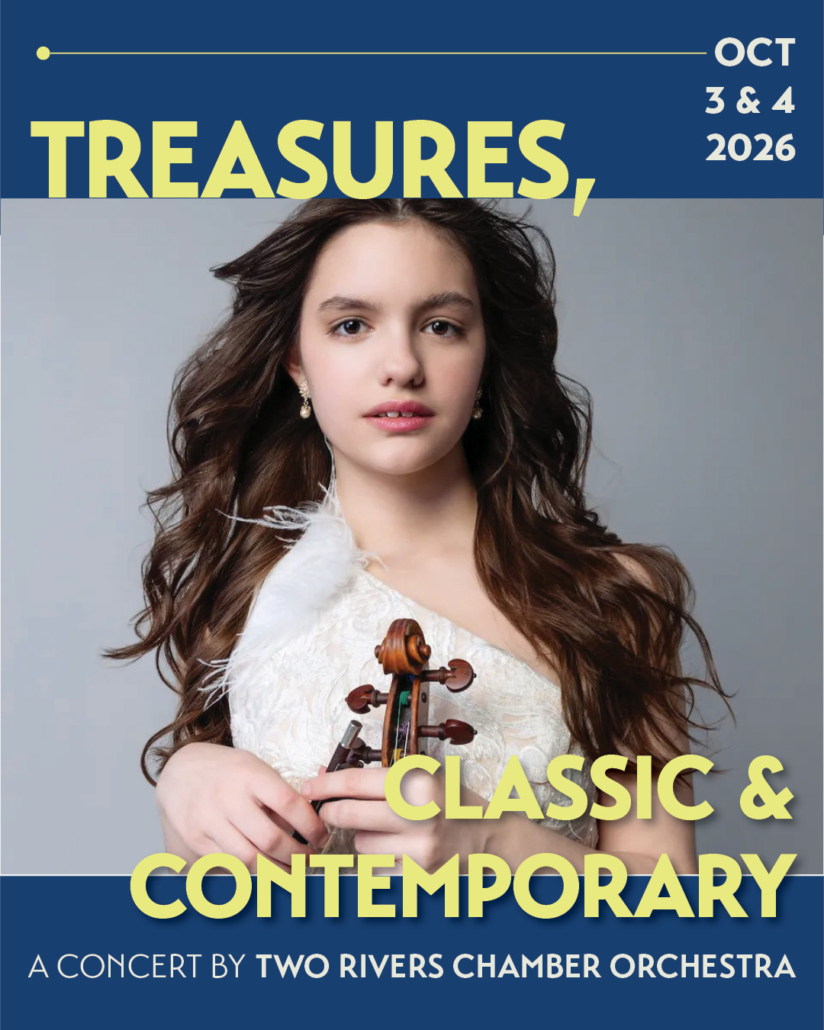
Treasures, Classic & Contemporary – Oct 3 & 4, 2026
Matthew Kimbley
(Born in Asheville, NC, in 2003)
Chariot of the Clouds
Chariot of the Clouds is a tribute to the fascinating literary imagery found at the beginning of Psalm 104, particularly verse 3: God “lays the beams of His upper chambers in the waters, who makes the clouds His chariot, who walks on the wings of the wind.” Intrigued by the juxtaposition of the stable elements (beams, chariot, measured walking) and unstable ones (waters, clouds, wings, wind), Kimbley sought to capture that contrast in his inspired work. Grounded rhythms and melodies are set against unsettled gestures and harmonies, at times counteracting and at other times supporting each other.
Nature and literature are Kimbley’s two primary sources of inspiration, with the poetic writings of the Bible holding a special place in his creative imagination. Chariot of the Clouds brings these influences together through vivid combinations—rumbling chariots and majestic fanfares alongside moments of sacred peace and contemplation. Scored for chamber orchestra, the work moves fluidly between grandeur and intimacy, allowing powerful displays and quieter passages to illuminate one another.
Vibrant rhythmic motifs introduce the piece, featuring varying divisions of its 9/8 meter. The energetic opening explodes in a flourish before descending into a peaceful melody, still underpinned by the previously introduced rhythms. This cascade continues into a slower walking section with increasingly erratic harmonies, eventually returning to the spirited, regal theme. The piece concludes with the rhythms compressing and colliding, as listeners imagine the chariot ascending heavenward and disappearing into the distance.
Chariot of the Clouds was commissioned by Friends of Music/Two Rivers Chamber Orchestra, Jed Gaylin, Music Director, thanks to the generous gift of Captain J. Kimo Williams (Retired U.S. Army) and his J. Kimo Williams 2026 Music Commissioning Initiative. The concerts on October 3 and 4, 2026, are the premiere performances of this work.
© Matthew Kimbley
Samuel Barber
(Born in West Chester, PA, in 1910; died in New York City, NY, in 1981)
Concerto for Violin and Orchestra, Op. 14
1. Allegro
2. Andante
3. Presto in moto perpetuo
The American composer Samuel Barber showed a precocious musical talent by age seven. He studied voice and piano seriously at his home in West Chester, Pennsylvania, until at age 14 he was accepted into the newly formed Curtis Institute of Music in Philadelphia. Soon after graduating from Curtis, he won the coveted Prix de Rome for composition. His reputation as one of America’s preeminent composers then steadily grew, and he was celebrated for his exquisitely tuneful works blended with distinctively modernistic twists, winning him Pulitzer Prizes for Music Composition in 1958 and 1963.
In 1936, Barber’s first great success drew worldwide attention when his masterfully beautiful Adagio for Strings was showcased by the famous conductor Arturo Toscanini. In 1939, Barber’s reputation as an up-and-coming composer won him a commission from the wealthy Philadelphia industrialist Samuel Fels to write a violin concerto on behalf of the prodigy Iso Briselli (1912 – 2005), a classmate of Barber’s at the Curtis Institute. Ultimately, following an insurmountable disagreement, Briselli never played the Concerto for Violin and Orchestra, and the work was instead premiered in 1941 by the American violinist Albert Spalding, with Eugene Ormandy and the Philadelphia Orchestra. The performance launched Barber’s concerto firmly and lastingly as one of the best-loved violin concertos in the repertoire.
Barber’s exceptional gifts for melodic beauty are supremely evident in this concerto. From the outset of the first movement, Allegro (fast), the solo violin sets the tone of winsome lyricism for the entire movement. The violin solo begins the concerto virtually alone, over the barest of orchestral accompaniment, singing a rhapsodic theme, soaringly tuneful and happily meandering. This rhapsody then makes way for a jaunty and cheerful new theme about one and a half minutes later, first played in the clarinet. This clarinet theme features a frisky rhythmic device called a “Scotch snap” — a syncopated rhythm with a very short note followed by a longer one — which adds a joyful lightheartedness. These two themes dance through the rest of this movement, alternating in a number of ways between each other, with occasional tempo changes and moody dramatic climaxes. A particularly brilliant musical effect is Barber’s use of the piano in the orchestral fabric, creating crystalline punctuations in the musical lines. The movement draws serenely to a calm and pulsating close, ebbing with quiet dignity.
The second movement, Andante (slowly), begins with a haunted hush, with muted strings and whispering horns setting a backdrop over which a poignant oboe melody rises. This simple oboe theme, singularly beautiful and melancholic, is the kind of theme that only Barber seemed to be able to write, reminiscent of his 1936 Adagio for Strings (and many other gems). After two and a half minutes of this tender, searching music, the solo violin finally enters. The music then turns increasingly restless, melodically twisting from its former gracefulness to apprehensiveness, as if grappling with an inner darkness. This unrest eventually finds its way back to the original oboe theme, now played by the solo violin, arising quietly, as if it had been patiently waiting for the angst to subside. A final treatment of that theme, with remnants of the violin’s earlier passages of turmoil, builds to a grand and magisterial climax with full orchestra. The movement then wanders softly, retreating into an ethereal quietude.
In the concerto’s relatively short final movement, Presto in moto perpetuo (very fast in perpetual motion), lyricism is thrown to the wind. Beginning with the timpani’s quietly racing triplets, the solo violin takes up the breathless pacing at breakneck speed, with triplet patterns in almost every bar until the movement’s conclusion. As the violin’s virtuosic pyrotechnics rush by, almost all the instruments in the orchestra whirligig along with matching brilliance. From the first measure’s mad-dashing-ness to the ending bar, Barber’s finale is a maelstrom of perpetual motion, like a rock tumbling at full speed down the side of a mountain. The concerto culminates with syncopated exclamations in the brass, punctuating their way to this great work’s exhilarating ending.
© Max Derrickson
Franz JosePH Haydn
(Born in Rohrau, Austria, in 1732; died in Vienna, Austria, in 1809)
Symphony No. 104 in D Major, H. 1/104 “London”
1. Adagio — Allegro
2. Andante
3. Menuet — Allegro
4. Finale — Allegro spiritoso
A musical pioneer and genius, the Austrian composer Franz Joseph Haydn paved the way for several classical era genres, most notably the string quartet, the concerto form, and the symphony. Indeed, he is often considered the “father” of symphonies and his last, Symphony No. 104, “London,” is arguably his crowning achievement.
As a musical employee of the very generous Esterhazy family of the Austro-Hungarian Empire, Haydn’s talents gained him international fame, and the Esterhazys gave him considerable freedom over what and where to compose. With their blessing, Haydn accepted invitations to London, first in 1791–92 and then in 1794–95, from the German music impresario Johann Salomon (1745 – 1815). In London, Haydn enjoyed such flattering enthusiasm from concertgoers, he was inspired to write 12 new symphonies, No. 93 through No. 104, that as a group constitute his London symphonies. Though some of these have nicknames, it is not clear why his final one, No. 104, is the only one known as the “London.” Nonetheless, it quickly became his most beloved of the complete set and has justifiably been an audience favorite for over 200 years — being filled with a grand bouquet of Haydn’s compositional gifts: pathos, bright cheer, humor, and incredible craft.
The opening sequence, Adagio (slowly, gracefully), begins a spellbinding introduction cast in the dark key of D minor (not D Major, as one might expect). The first four notes are loud and ominous, like a call to arms. This slow introduction then continues in the strings, becoming emotionally freighted, like a funeral march, periodically interrupted by those arrestingly loud opening four notes. A moment of profound silence soon saturates the air with gravity, and at this instant, following such a pathos-filled beginning, Haydn proves that he is the master of surprises. The Allegro (fast) that follows features a theme brimming with lyricism, lightness, and optimism — as though we have been dropped into an entirely different symphony. The movement mostly proceeds in this wonderfully pleasant manner, though a slightly more aggressive second theme, starting at about six and a half minutes, lightly recalls the minor mode pathos of the introduction. The two themes eventually come to complement each other, and this magnificent opening movement concludes with light-filled majesty.
The second movement, Andante (moderately slow, at a walking pace), begins in the strings using a small motive taken from the first movement’s dark introduction — a carryover and reweaving technique that Haydn uses for every main theme in this symphony. Here, he transforms some of that introductory material into a new theme that becomes a songlike reverie filled with charm and beauty. Then, into the midst of this reverie, a brief section intervenes in a solemn minor key, begun softly in the winds and led by the flutes. A few measures later, the energy becomes poignant with loud outbursts in the strings, brass, and timpani. Soon, however, the earlier musical reverie returns to conclude the movement, ending with the two French horns creating a glowing goldenness, as this movement comes to its gentle close.
The third movement, fashioned on a popular eighteenth century aristocratic courtly dance called a menuet, serves the purpose of variety, as a kind of confection of musical manners, and to counterbalance the weightiness of the movements that surround it. Here is where Haydn adds delicious humor with the playfulness for which he is famous. The first theme begins outright in the full orchestra, reserved and with a hint of gallantry. This theme repeats twice, and then during its third iteration, the accompanying instruments seem to get stuck in a riff that keeps tumbling over itself — first occurring in the bassoons, and then with the basses getting caught with them — throwing its dancers off-kilter. The next phrase contains some pauses that are mischievously too long for dancing. Add a few raucous timpani rumbles, and one senses Haydn poking a bit of fun at courtly dancing snobbery. As for confection, there are some delightful and prominent oboe, bassoon, and flute passages on full display in the contrasting middle section.
The finale, Allegro spiritoso (fast and spirited), opens with a quiet drone in the basses and horns that resembles the sound of a bagpipe. Over this drone, the first theme is heard immediately in the violins, and it is robust and infectiously cheerful, like a folk dance. Some musicologists consider this opening tune to be of Croatian origin (and if they are correct, Haydn would likely have heard it from immigrants who lived close to his birthplace in Rohrau, Austria); others suggest that this tune hearkens to the plaintive call of London street vendors, which may have helped the symphony get its nickname of the “London.” In any case, as a master of musical molding, Haydn shapes and reshapes this theme into some wonderful musical friskiness throughout the finale. Motives from the earlier movements arise slyly, too, blending brilliantly into the joyful musical fabric, until this finale winds itself up into a romping coda (a brief concluding section) that is surely one of the most exuberant conclusions in any of Haydn’s symphonies.
© Max Derrickson
Thank you to Wind Gap Music for sponsoring our program notes!